



Next:Football

The place behind the pride

StarkvilleThen & now.

Old streets. New chapters.
The making of our college town.

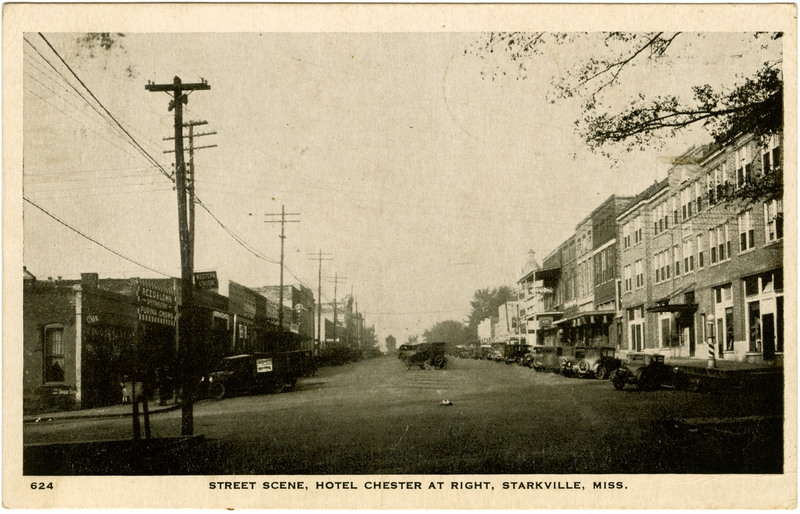
Historic Starkville street postcard showing vintage cars and Hotel Chester on the right
Starkville street scene · Undated historic postcard

1835–1870s

Before the cowbells, a county seat.

Starkville had a story long before it had a college. Known early on as Boardtown, the community became the Oktibbeha County seat in 1835 and took the name of Revolutionary War general John Stark.

The longer story

This is Choctaw homeland. The 1830 Treaty of Dancing Rabbit Creek ceded the land under pressure and led to the forced removal of many Choctaw people. The county seat that followed grew into a center of shops, churches and public life. Before the Civil War, the surrounding cotton economy depended on enslaved labor. Rail service arrived in the 1870s.

  1. Before 1830Choctaw homeland
  2. 1835Starkville becomes the county seat
  3. 1870sRail service reaches town
Chapter 1 of 4

From a county seat to a college town

Starkville through the years.

Follow the railroads, classrooms, workplaces and people who helped shape the town.

  1. Before 1830

    Choctaw homeland

    The town’s history begins with the people who lived on this land long before Starkville existed.

    Read the history
  2. 1830

    A treaty and forced removal

    The Treaty of Dancing Rabbit Creek led to the cession of Choctaw land and the forced removal of many Choctaw families.

    Read the history
  3. 1835 / 1837

    A county seat becomes a town

    Starkville became the Oktibbeha County seat in 1835. The Mississippi Legislature incorporated the town in 1837.

    Read the history
  4. 1874

    The railroad arrives

    A Mobile and Ohio branch connected Starkville with the main line at Artesia, bringing the town into a wider transportation network.

    Read the history
  5. 1878 / 1880

    A college next door

    Mississippi A&M was established in 1878 and opened to students in 1880. The new college would reshape the town’s future.

    Read the history
  6. 1897

    A school at the heart of a neighborhood

    Starkville Public School opened at Jackson and Green streets. Its building became Overstreet School and was enlarged over the years.

    Read the history
  7. 1902

    The cotton mill begins production

    The mill on Russell Street became a major part of Starkville’s working life. Its story would later include university use and restoration.

    Read the history
  8. 1926

    Downtown and industry grow

    Hotel Chester was completed and Borden opened a milk condensing plant, linking local agriculture with new jobs and commerce.

    Read the history
  9. 1927 / 1928

    A changing Main Street

    A county hospital opened in 1927. By 1928, the principal business and residential streets were paved, after the town had only one paved street in 1923.

    Read the history
  10. 1932 / 1958

    Becoming Mississippi State

    A&M became Mississippi State College in 1932, then Mississippi State University in 1958.

    Read the history
  11. 1965

    Richard Holmes enrolls

    Holmes became Mississippi State’s first African American student, a landmark in the university’s desegregation.

    Read the history
  12. 1969

    A new chapter for the Cotton District

    Dan Camp began developing housing on Lummus Drive in a former mill neighborhood, starting the district’s gradual transformation.

    Read the history
  13. 1976

    A depot becomes a keeper of memories

    The Oktibbeha County Heritage Museum was established during the nation’s bicentennial. Its home is an 1874 railroad depot.

    Read the history
  14. 2015

    A place to remember civil rights

    Unity Park’s completed design brought a public space for remembrance to Douglas L. Conner Drive, with plaques and a local civil rights timeline.

    Read the history

Postcards from the archives

A closer look at old Starkville.

Four more windows into town life. Tap a postcard to see the full image.

20th century · Exact year unknown

Cotton waiting at the oil mill

The archive titles this scene “Waiting to Be Ginned.” It records the movement of cotton through town.

MDAH · Cooper Collection · Item 3615 ↗
20th century · Exact year unknown

The cotton warehouse

A second view of the cotton trade, showing the storage and commercial side of an agricultural town.

MDAH · Cooper Collection · Item 3616 ↗
20th century · Exact year unknown

The courthouse on a postcard

The postcard calls it the “New Court House.” The catalog does not identify the year the view was made.

MDAH · Cooper Collection · Item 3612 ↗
20th century · Exact year unknown

First Presbyterian Church

Church buildings were part of the townscape that visitors and residents sent home on postcards.

MDAH · Cooper Collection · Item 3649 ↗

Courtesy of the Mississippi Department of Archives and History. These public domain postcards are cataloged as “19xx”; exact photograph dates are not recorded. Original coloring and lettering are preserved. Collection notes ↗

The places between the landmarks

Streets with stories to tell.

Greensboro Street

The streets remember

Greensboro Street follows part of an early road leading west. Its surviving houses trace changing tastes, from Greek Revival and Queen Anne to bungalows. After World War II, residents added apartments, duplexes and smaller homes to accommodate veterans studying at Mississippi State College and their families.

Explore this story ↗

Overstreet & South Lafayette

A neighborhood beyond the postcard

The Overstreet district preserves homes built as Starkville grew between 1870 and 1940. Its history also records racial inequality, including housing for Black domestic workers behind white households. South Lafayette Street was home to Black community leader and Main Street businessman Robert Weir.

Explore this story ↗

The Cotton District

Before the restaurants and courtyards

The neighborhood grew around mill work. The area known as Needmore included housing for Sanders Cotton Mill workers. After the mill closed in 1964, Dan Camp began developing the area in 1969. The district’s shops, housing and small streets grew from that longer industrial story.

Explore this story ↗

The Heritage Museum

A town keeps its everyday history

Founded in 1976, the Oktibbeha County Heritage Museum preserves local artifacts in an 1874 Mobile and Ohio depot. School and church keepsakes, household objects and industrial history help tell the stories of people whose lives do not always appear in the headlines.

Explore this story ↗

Cotton waiting at the oil mill

Historic postcard of wagons carrying cotton outside the Starkville Oil Mill

20th century · Exact year unknown

Open the archive record and zoomable original ↗
Sources & photograph notes

The stories are based on university, municipal and state histories. Archival photographs show the dates in their captions, not necessarily the beginning of each chapter.

From the archives

Historic postcards: Courtesy of the Mississippi Department of Archives and History. The Cooper Postcard Collection is public domain. Exact years are not recorded for the two town views; they are not photographs of the chapter's opening year. The Textile School postcard is cataloged as early twentieth century. Original postcard coloring and lettering are preserved.

Present-day Davis Wade Stadium photograph supplied and taken by the StarkVegas Report owner.